P16S: Auckland to Papeete
January 14, 2027
Overview
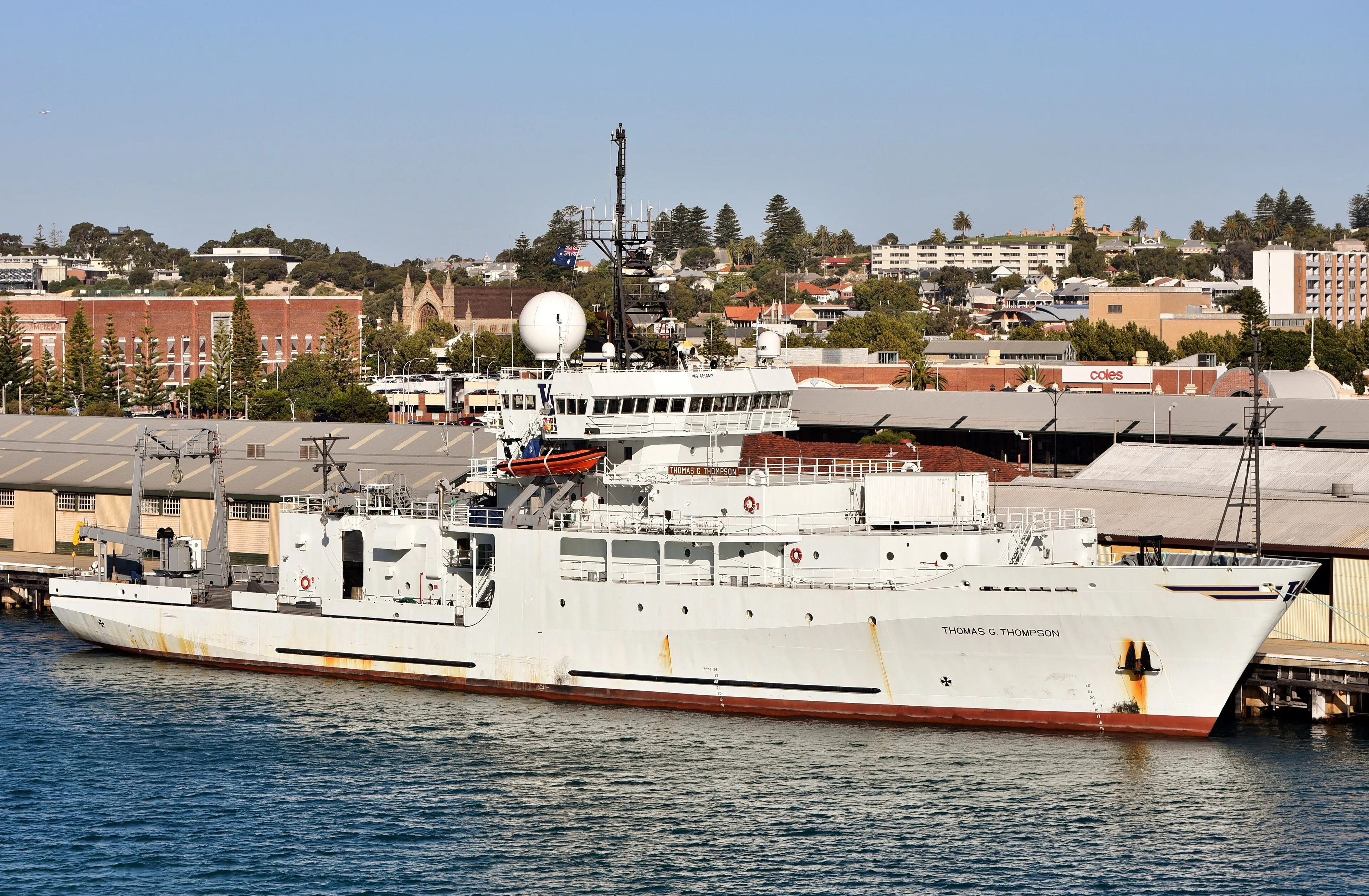
GO-SHIP P16S (Leg 1) runs along roughly 150°W in the South Pacific aboard the R/V Thomas G. Thompson (University of Washington), from January 14 to March 6, 2027, for 53 days at sea. Mobilization takes place January 10–13, 2027.
- Start: Auckland, New Zealand (Port of Auckland, Captain Cook Wharf)
- End: Papeete, Tahiti
Leadership
- Chief Scientist: Leah Chomiak (U. Miami CIMAS / NOAA AOML)
- Co-Chief Scientist: Steffi O’Daly (UW CICOES)
- Captain: Eric Haroldson
Ship and crew
The R/V Thomas G. Thompson operates at full science capacity with about 34 science berths, including marine technician and medical staff support.
Operations
- About 108 core GO-SHIP stations spanning 71°S to 17.5°S.
- About 25 Bio-GO-SHIP casts.
- Core measurements: CTD/rosette, bottle salts, dissolved oxygen, nutrients, Total CO₂ (DIC), underway pCO₂, total alkalinity, pH, CFC-11, CFC-12, SF₆, Lowered ADCP (LADCP), and Shipboard ADCP (SADCP).
- Level 2 and Level 3 measurements: Δ¹⁴C and δ¹³C of DIC, N₂O concentration, Bio-GO-SHIP (pigments, flow cytometry, imaging, eDNA), CTD transmissometer, N₂O isotopocules, Underwater Vision Profiler (UVP), CTD FDOM suite, ammonium, aerosols, and water isotopes (δ¹⁸O).
- Platform deployments: BGC-Argo floats, Deep Argo floats, and surface drifters.
Planning information
Data management and archival. All core hydrographic data are processed and submitted to the CCHDO (CLIVAR and Carbon Hydrographic Data Office) following standard GO-SHIP guidelines.
Logistics and compliance.
- Strict biosecurity regulations apply (e.g., New Zealand biosecurity clearance, ISPM-15 compliant treated wood standards for shipping containers).
- All participating personnel must complete required onboarding profiles (such as UNOLS Marine Facilities Planning) and review the US GO-SHIP Code of Conduct.
- Mandatory pre-cruise training (such as joint Bystander Intervention Training) is coordinated ahead of field operations.