I09N: Fremantle to Phuket
March 21, 2016
Overview
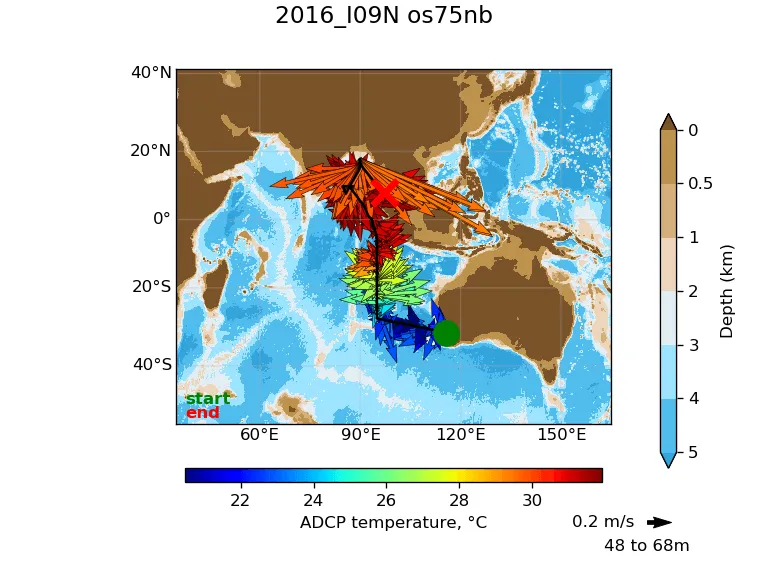
GO-SHIP I09N 2016 ran aboard the R/V Roger Revelle from Fremantle, Western Australia, to Phuket, Thailand, from March 21 to April 28, 2016. Leticia Barbero (NOAA AOML) was chief scientist and Carmen Rodriguez was co-chief scientist. The cruise was the northern continuation of I08S, which the Revelle had finished on March 17.
The section runs north along 95°E from 28°S to about 5°S, then veers northwest to stay in international waters and continues into the Bay of Bengal. It repeated the 2007 occupation, including the “bow-tie” in the Bay of Bengal: a triangle running along 10°N between roughly 85°E and 90°E and down to about 7°N on 85–86°E. The 10°N leg reoccupied part of WOCE line I01E, which had been sampled only once, in 1995. The team occupied 113 stations at 20–30 nautical mile spacing, deployed 8 Argo floats, and carried out 28 trace metal casts and 23 bio-optical casts. A science party from 17 institutions took part.
For Bio-GO-SHIP, the Martiny lab (UC Irvine) worked with the Lomas and Twining labs (Bigelow Laboratory for Ocean Sciences) to link plankton diversity to biogeochemical cycles across the central Indian Ocean. Cathy Garcia and Nathan Garcia sampled the ship’s flow-through seawater system at every station and roughly halfway between stations. That gave genomics and particulate organic matter (POM) data at 1/4° to 1/2° resolution along the whole line, plus 15 stations on the way out from Fremantle. In total they collected 600 Sterivex DNA samples and 705 POM filters. From station 113 onward, they also took genomics samples at or just below the deep chlorophyll maximum, targeting the primary nitrite layer, at every odd-numbered station.
Operations
The cruise report notes that no major problems came up and all science goals were met. Good weather and reliable equipment left enough time to add two “bonus” stations at the western end of the 10°N line, extending the I01E reoccupation as far west as international waters allowed and bringing the total from 111 to 113. Two stations were moved slightly from their 2007 positions to stay out of India’s EEZ. The northernmost station ended up at 17.883°N instead of 18°N.
On April 3, at station 115, the team lost communication with the CTD at 3,000 m on the upcast. A conductor in the sea cable had shorted, so they switched to another conductor, re-terminated, and repeated the cast. Stations 103–105 were deeper than 6,000 m, deeper than the rosette’s pressure rating, so the deepest bottle was fired at 6,000 m. The 1995 and 2007 occupations had the same gap. Later in the cruise, extruded seals on the carousel’s bottle-release magnets forced the team to take three Niskin bottles out of service. By then the deep stations were done, so this barely affected the vertical resolution.
Scientific highlights
Three “regional stations”, at about 20°S, 5°S and 8°N, sampled the Indian Southern Subtropical Gyre, the equatorial upwelling region, and the Inter-Monsoon Gyre in the Bay of Bengal. At each one, an extra shallow rosette cast collected samples for diversity, nutrient uptake kinetics, and nitrogen, phosphorus and iron limitation bioassays. Surface nutrients in the subtropical gyre were below detection, and the nutricline shoaled between about 12°S and 5°S.
In the Bay of Bengal, the team sampled a large oxygen minimum zone and waters freshened by river runoff. Working with Chawalit Charoenpong (WHOI), they collected DNA from the oxygen minimum zone and the upper and lower oxycline, from station 149 onward, to study ammonia-oxidizing and anammox bacteria. The report describes these UC Irvine, Bigelow and WHOI collaborations as a highlight of the cruise.
Fun facts
- One CTD watchstander downloaded weather maps every day to keep everyone up to date. The team watched Tropical Cyclone Fantala form to the west. With winds above 175 mph, it was the strongest tropical cyclone on record in the Indian Ocean, and it stayed well away from the cruise track.
- A Thai PhD student shared the midnight-to-noon CTD watch, and the team practiced Thai phrases ahead of arriving in Phuket.
- One watchstander kept an outreach blog that elementary and middle school classes followed during the cruise.