I07N: Durban to Goa
April 23, 2018
Overview
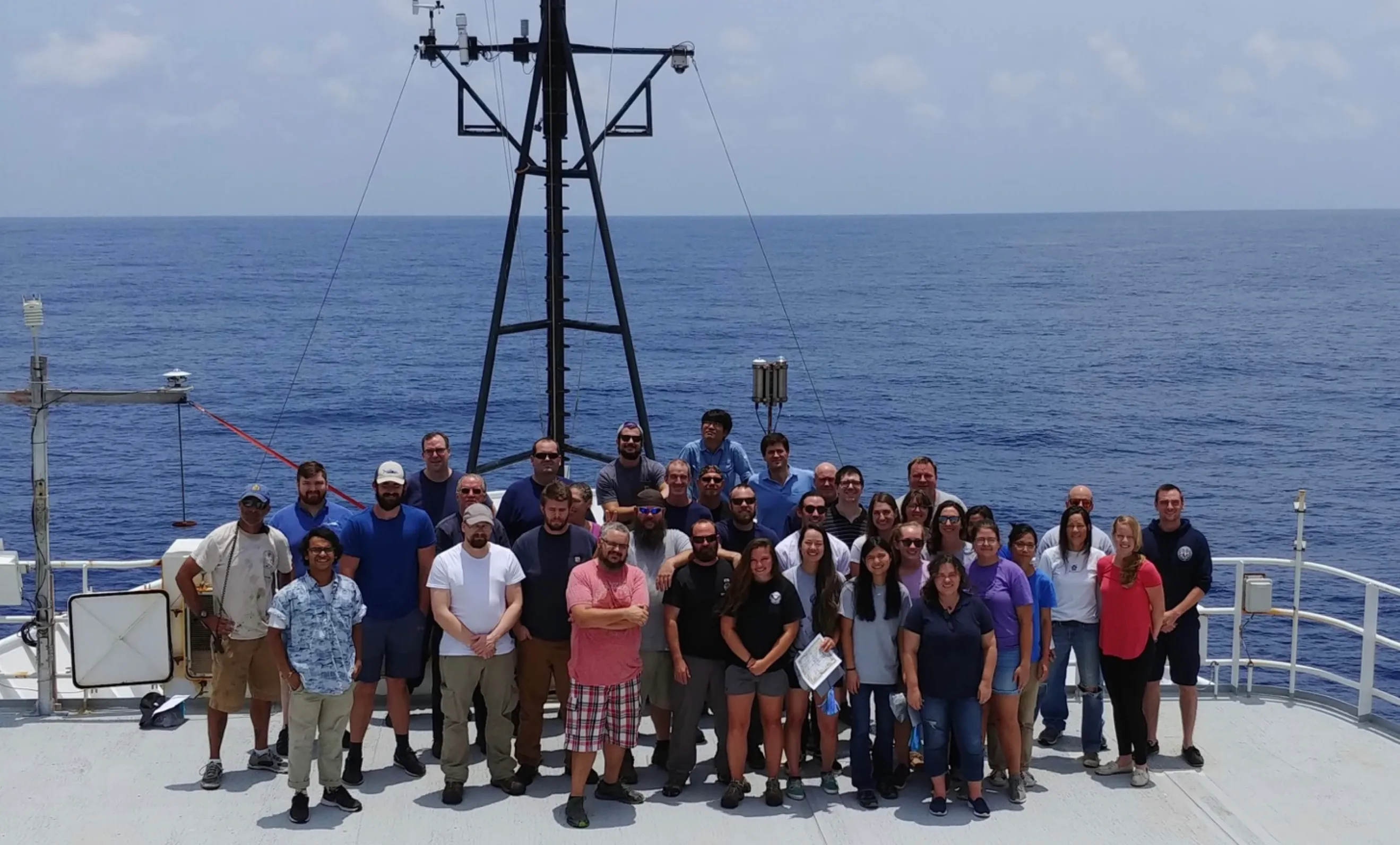
GO-SHIP I07N ran from April 23 to June 6, 2018, aboard the R/V Ronald H. Brown. Leg 1 went from Durban, South Africa, to Victoria, Seychelles, and Leg 2 went from Victoria to Goa, India. Chief Scientist Denis Volkov (AOML/CIMAS) and Co-Chief Scientist Viviane Menezes (WHOI) led 26 scientists from 15 institutions.
It was the first reoccupation of I07N since 1995. The line had gone unsampled for 23 years because of piracy in the region.
The section crosses the Madagascar and Mascarene Basins, the Amirante Trench, the Seychelles Bank, the Somali Basin, and the Carlsberg Ridge before ending in the Arabian Sea. The Arabian Sea’s oxygen minimum zone (OMZ) is the thickest of the three major oceanic OMZs.
The cruise completed 126 CTD casts (including 2 test casts) with a 24-bottle rosette and deployed 15 Argo floats, 10 SVP drifters, and 3 wave buoys.
For Bio-GO-SHIP, the Martiny lab (UC Irvine) collected 54 surface genetics samples, about one every half degree of latitude, plus underway genetics samples every four hours and 749 underway particulate organic matter samples. The samplers were Catherine Garcia and Jenna Lee.
A team from UMCES Horn Point Laboratory (Victoria Coles and Hannah Morrissette) ran several biological programs:
- Underway plankton imaging (FlowCAM) and phytoplankton physiology (mini-FIRe) measurements
- Daily oxygen-based primary productivity incubations
- HPLC pigment, chlorophyll, absorption, and CDOM sampling for ocean-color validation
- 14 nighttime net tows to look for ocean-acidification damage in the aragonite shells of pteropods
Operations
Engine problems pushed the cruise back from its original February start. Most of the science gear had already been loaded in Charleston and Fort Lauderdale, so mobilization in Durban was quick.
The aft winch caused data errors on the first test cast and couldn’t be fixed at sea. The whole cruise ran on the forward winch, with no backup.
Station 24 was moved 10 nm west to avoid French military exercises off La Réunion.
Getting research clearances was the biggest problem of the cruise:
- Mauritius: Clearance arrived only hours before the ship entered the Mauritius EEZ, after NOAA’s Climate Program Office reached a contact in the Mauritian government.
- Seychelles: Clearance had not arrived when the ship reached the edge of the Seychelles EEZ. All science stopped at midnight, and the ship waited a full day at the boundary. Five stations around the Amirante Trench were then cancelled to get back on schedule.
- India: The conditional clearance included a possible naval inspection, which the ship’s leadership could not accept, so it was effectively denied. From station 111 the cruise switched to a backup route that ran close to the Indian continental slope while staying outside the Indian EEZ.
Safety concerns kept the ship from following the 1995 route to Oman. Instead, the team used the remaining time to push northwest into the OMZ, reaching 18°N, the furthest north the ship would go.
North of the Seychelles, a strong surface jet (likely the seasonal Wyrtki Jet) ran east at more than 1 m/s above a westward current at 100–200 m depth. This twisted and damaged the CTD cable, which had to be re-terminated several times, with 250–300 m of wire cut off. Conditions improved once the ship left the current.
Other setbacks:
- A search for a PMEL mooring that had been silent for five years found no trace of the buoy.
- Extra crew were needed for security watches in the High-Risk Area, which cut the science party by two and left no dedicated data manager.
Scientific highlights
CFC concentrations in Antarctic Bottom Water were much higher than in 1995. This indicates that new bottom water formed over the past 23 years and spread all the way into the tropical Indian Ocean.
Antarctic Intermediate Water was not seen north of about 14°S.
LADCP data at station 33 showed vertical velocities of up to 4 cm/s between 300 and 1,000 m, caused by an internal wave.
In the Arabian Sea, CTD watchstanders saw oxygen drop to zero in real time. The OMZ filled a layer from about 150 to 1,000 m deep.
The team also found unusually low oxygen near the seafloor between stations 104 and 114, a feature that was not prominent in 1995.
Over almost 40 days at sea and about 5,200 nautical miles, the team collected and analyzed more than 36,000 liters of seawater from depths between 5 and about 5,500 m.
Fun facts
- The first SVP drifter was deployed in the Agulhas Current on day one.
- The safety drills included an “egress” drill in which everyone had to find their way out blindfolded.
- On clear evenings, sunsets on the port side were followed by moonrises on the starboard side.
- The FlowCAM’s clogged flow cell was finally cleaned with Dawn dish soap.
- A “bonus” drifter was deployed in the Wyrtki Jet.
- The post-Seychelles group photo shows only 18 of the 26 scientists. Nobody was left behind: the rest were taking the photo or watching the rosette being rewired.
- The weather stayed calm well into the monsoon season. The team joked that, since this was a NOAA cruise, the National Weather Service was taking special care of them.