C13.5: Cape Town (A13.5 cut short by COVID-19)
March 21, 2020
Overview
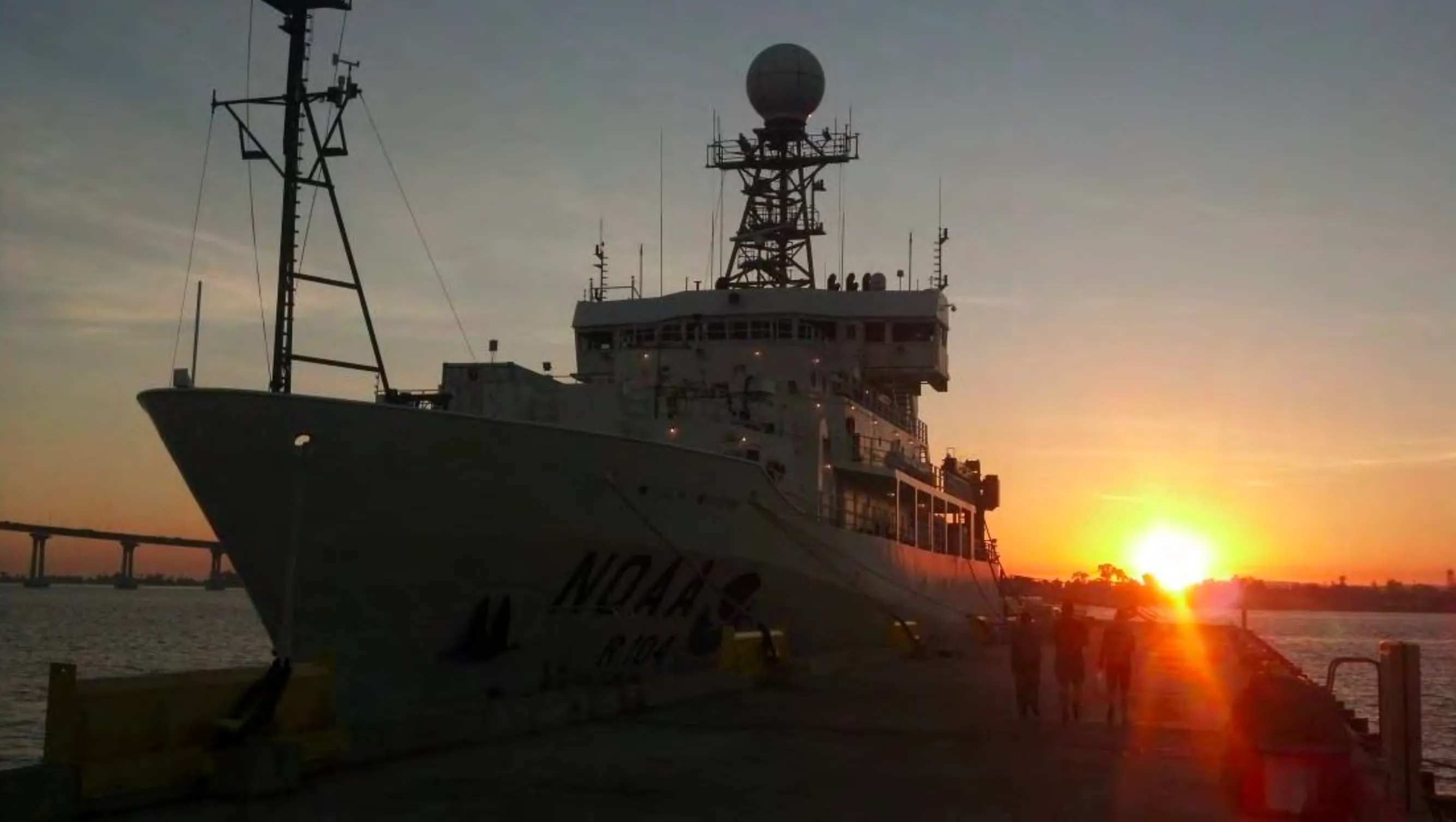
GO-SHIP A13.5 2020 sailed aboard the NOAA Ship Ronald H. Brown from Cape Town, South Africa, on March 21, 2020. Leticia Barbero (NOAA AOML) was chief scientist and Courtney Schatzman was co-chief scientist. The cruise was meant to reoccupy the A13.5 line (along with part of A12) for the first time since 2010, but the COVID-19 pandemic began just as it was due to depart. The cruise is informally known as C13.5 to distinguish it from bona fide occupations of the A13.5 line.
Operations
South Africa’s borders were closing as the science party arrived, and the team had to plan for 17 participants instead of 27. Once at sea, the ship was limited to a seven-day science window within a 96-hour steam of Cape Town, in case anyone aboard turned out to be infected. Given the short window and a storm heading their way, the team chose to focus on deploying six SOCCOM biogeochemical Argo floats rather than attempting the full section. They occupied 8 full-depth CTD stations of the 129 planned: two near 41°S, 3°E, and six along 1°E between 37°S and 32°S. The ship was then ordered home and crossed the Atlantic to the United States, with the cruise ending on April 17.
Bio-GO-SHIP sampling
The Martiny lab (UC Irvine) kept sampling throughout the transit, so the cruise still produced a basin-scale underway dataset. Triplicate particulate organic matter (POM) samples for carbon, nitrogen and phosphorus were filtered from the ship’s flow-through seawater system (intake about 5 m deep) roughly every four hours, with the schedule shifted an hour later each day. Underway sampling ran from near Cape Town, through the stations, and across the Atlantic to about 36.1°N, 74.6°W off the US East Coast; the map shows this full sampling track. The POM data are at BCO-DMO, and DNA sequences are in the Bio-GO-SHIP BioProject at NCBI.
A13.5 was finally reoccupied in 2024 on the R/V Marcus G. Langseth, after a second attempt in 2022 was also cancelled.